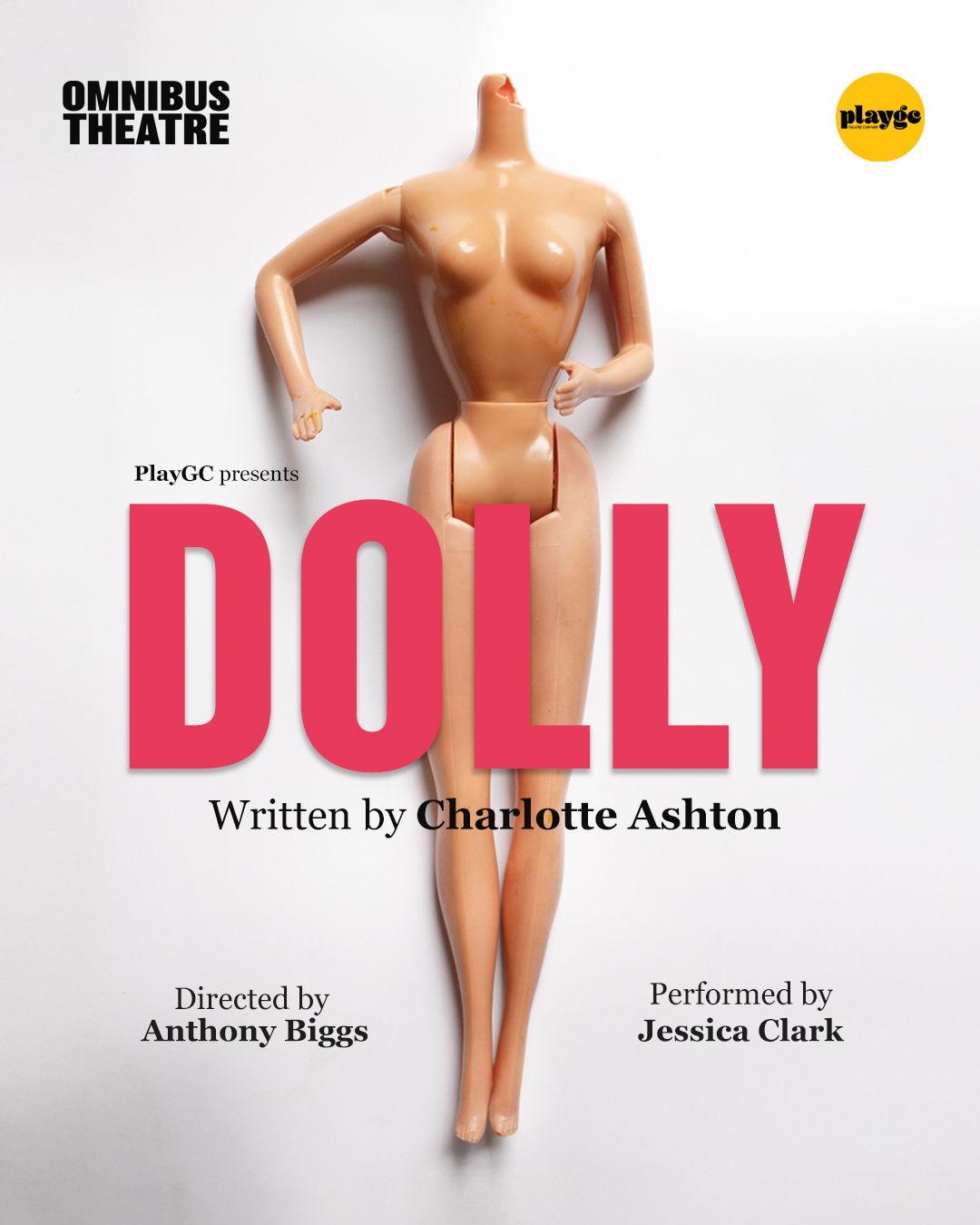

Theatre Muse hosted an interesting discussion with Charlotte Ashton looking inside her writing process, and learning more about Charlotte’s new play Dolly due to begin a run at The Omnibus Theatre, London on the 20th October-7th November 2026.
Can you share with us the storyline of your play ‘Dolly’? And, is the character Dolly based upon a real person or is she fictitious?
DOLLY is a one-woman play about a stand-up comedian whose life is turned upside down by a sexual assault. It follows her attempts to navigate the criminal justice system and, ultimately, to find a way of living with what has happened to her.
But it’s not quite the play you might expect from that description. Dolly is funny, irreverent, contradictory and sometimes spectacularly inappropriate. She’s someone who makes sense of the world by making jokes about it, and she doesn’t suddenly stop being that person because something terrible has happened. In fact, her humour becomes an important part of how she tells her story.
The play moves between her experiences of relationships, sex, work, the police and therapy, exploring the strange and often absurd territory surrounding sexual violence. At its heart is a question that troubled me throughout the writing: what happens to women who are expected to heal in the absence of justice?
Dolly is fictional, although she’s drawn from a great deal of research and from experiences that will, sadly, be familiar to many women. I was interested in the cumulative effect of the everyday sexism, harassment and unwanted sexual attention that girls and women encounter long before anything that might be recognised as a serious crime.
So, Dolly isn’t based on one woman. In some ways, she’s an amalgam of many women’s experiences, filtered through the imagination of a character who has a very particular way of looking at the world.
And there are a few surprises along the way, which I certainly don’t want to spoil!
Stand-up comedy is a tough job. Is there is reason why you chose this job for your character Dolly?
Originally, Dolly wasn’t a stand-up comedian at all. I knew what I wanted to write about, and I’d done an enormous amount of research, but I was struggling to find the right dramatic form. The subject felt so serious that I was in danger of writing something terribly solemn, which wasn’t what I wanted.
The breakthrough came during my time with the Royal Court Writers’ Groups, when I began to realise that comedy might offer a much more interesting way into the material.
I thought about work like Fleabag, I May Destroy You and Promising Young Woman, which uses humour, often very dark humour, to explore women’s sexuality, power and violence. Comedy can take us into places that straight drama sometimes struggles to reach. It allows for contradiction, absurdity and the sort of uncomfortable laughter that makes you wonder why you’re laughing.
Making Dolly a stand-up also gave her control over the room. A comedian chooses what to reveal, when to reveal it and how an audience responds. That becomes particularly interesting in a story about someone whose control over her own life has been profoundly challenged.
And I was determined that Dolly should be a fully rounded woman, not simply a victim. She’s ambitious, opinionated, sexually curious, occasionally infuriating and genuinely funny. The assault is something that happens to her; it isn’t the sum total of who she is.
The crucial distinction for me is that the assault itself is never the joke. The comedy comes from Dolly’s observations and from the ludicrous attitudes and systems she encounters. It’s a serious play, but it doesn’t have to be solemn.
Rape and sexual assault are serious offences and there have been several prominent cases in the news recently. How did you research the background for your play’s content?
The play began during lockdown, when I was becoming increasingly concerned and angry about violence against women and girls. There seemed to be an endless succession of disturbing stories, including crimes committed by serving police officers, and I found myself thinking about the gap between what women are told about their rights and safety and what they actually experience.
I started reading widely: research into sexual violence, accounts of women’s experiences of reporting assault, material about the criminal justice system and the psychological aftermath of trauma. I was particularly interested in what I came to think of as the brackets around an assault: everything that precedes it, including the harassment and sexism women learn to accommodate, and everything that follows it, including the search for justice and the struggle to recover.
Some of the material I encountered was extraordinary, not least historical police interview transcripts that revealed attitudes towards women which now seem almost unbelievable. I wanted to bring some of that material into the play because it shows how deeply embedded certain assumptions have been.
One of the discoveries I made while writing was that the research didn’t simply have to inform the drama. It could become part of the drama itself. That opened up the possibility of blending documentary material with fiction, memory and Dolly’s own commentary.
I was also very conscious that sexual violence is not one universal experience. I wasn’t trying to speak for every survivor or offer a neat account of trauma. I wanted to ask difficult questions about the systems surrounding women, while creating a character whose experience felt human, complicated and particular.
You are working with director Anthony Biggs, who brings a wealth of experience to the table. How has working with an experienced director helped the creative process, and have you been involved in rehearsals?
Working with Anthony has been one of the great pleasures of bringing DOLLY to the stage. He has a huge amount of experience, including running Jermyn Street Theatre and the Playground Theatre, but what I’ve valued most is his curiosity about the play and his willingness to explore what it might become theatrically.
I first worked with him at a table reading at the New Diorama Theatre in spring 2025, funded by PlayGC Theatre Company. That was an extraordinary moment for me because it was the first time I’d heard the whole play spoken aloud by a professional actor. Suddenly, things that had existed only in my head became real — and, inevitably, some things worked rather better than others!
Anthony has been involved in the development ever since. We worked together again on a staged reading at Theatre503 earlier this year, this time with Jessica Clark playing Dolly. Jess was someone I’d admired in SAP and The Swell, and Anthony had independently identified her as an ideal Dolly, so that felt rather wonderful.
I’ve been involved in the rehearsal process, which has been fascinating. As a playwright, you can become terribly attached to the words on the page, but theatre is a collaborative art form. Anthony and Jess have found possibilities in the text that I couldn’t have imagined on my own.
What I love is that the production now feels like something we’ve all made together. It began as my play, but it has become ours — it’s what I wanted and it’s much richer for that.
How has being involved with the Royal Court Writers’ Group helped to develop your writing skills?
Getting a place on the Royal Court Writers’ Groups in 2023 was my first really lucky break as a playwright. I arrived with a great deal of research, a draft I was struggling with and a growing sense that I couldn’t see the wood for the trees. I’d become completely snow-blind.
Our group was led by the brilliant playwright and actor Charlie Josephine, with support from Gill Greer and Aneesha Srinivasan. Charlie encouraged us to read adventurous work and, more importantly, to be brave in our own writing.
That was enormously liberating. I think I’d been labouring under the tyranny of the well-made play — the idea that a piece of drama ought to fit a recognisable three-act structure, with all its parts behaving themselves. Charlie encouraged us to question those assumptions and trust our own instincts.
For DOLLY, that was transformative. I began to see that the research I’d accumulated could be theatrical material in its own right, and that the play didn’t need to proceed in the way I’d originally imagined. It could move between different registers, blending fact and fiction, and it could be funny.
Once I’d found Dolly’s voice as a stand-up comedian, the writing came remarkably quickly. It was as though she’d been waiting for permission to speak.
The Royal Court also provided dramaturgical support as I developed a second draft, which was invaluable. But perhaps the most important thing I took away was confidence: the understanding that there isn’t one correct way to write a play, and that sometimes the most exciting work happens when you stop trying to follow the rules.
Where does your inspiration come from for your writing? And do you have a process for developing ideas?
I think my ideas tend to begin with something that bothers me — a question I can’t answer, an injustice that makes me angry or a contradiction that I find both troubling and fascinating.
With DOLLY, it was my growing concern about violence against women and girls, but also the realisation that so much of the public conversation seemed to concentrate on individual crimes rather than the culture surrounding them. I kept thinking about the things women are expected to accept as normal, and about what happens after an assault when the institutions that are supposed to help don’t deliver justice.
My first instinct is usually to research. I read widely, follow tangents and collect material, often without knowing quite what I’m going to do with it. I enjoy that stage enormously, although there’s a danger of disappearing down a research rabbit hole and never emerging!
At some point, though, you have to find the human story. Facts and arguments aren’t enough to sustain a play. You need characters who surprise you, who contradict themselves and who want things.
I don’t think I have a particularly rigid process. DOLLY certainly didn’t develop in a straight line. I wrote an initial draft quite quickly, got stuck, then had to rethink almost everything about its form before the character came alive.
I’ve also learned how important it is to hear work aloud. A line that looks wonderful on the page can fall completely flat when spoken, while something quite unassuming can suddenly become electric. That’s one of the joys — and terrors — of writing for theatre.
How difficult is it to get a new play staged by a theatre?
Very! And I say that as someone who feels extraordinarily fortunate to be having her debut play produced.
There are so many talented playwrights writing wonderful work, and relatively few opportunities for new plays to be staged. Theatres are under enormous financial pressure, and producing new writing is a risk. So, writing a play is really only the beginning of the journey.
In my case, two extraordinary strokes of luck made all the difference. The first was getting into the Royal Court Writers’ Groups, which helped me turn a rather unwieldy draft into something that felt like a play.
The second involved a chip! I was at the opening night of Oli Forsyth’s BRACE BRACE at the Royal Court when I met Robert Gordon Clark of PlayGC Theatre Company. We got talking over a chip, as you do, and he very kindly offered to read my script.
Robert and his wife, Lisa Day, are passionate supporters of new writing, and within days they were both enthusiastic about DOLLY. PlayGC subsequently supported its development, introducing me to Anthony Biggs and funding our first table reading.
From there, we had the staged reading at Theatre503, where an audience of around fifty people gave us invaluable feedback. Eventually, The Omnibus Theatre welcomed the play into its autumn season.
Looking back, it’s been a combination of luck, generosity, collaboration and a great deal of hard work. And it has made me acutely aware of how important organisations and individuals who champion new writing are. Without them, so many plays would never make it off the page.
Are you working on anything new at the moment that you would like to share with us?
At the moment, DOLLY is taking up almost all the available space in my head! Having a first play produced is an extraordinary experience, but there are a thousand things to think about, from rehearsals and rewrites to publicity and the rather terrifying prospect of sitting in a theatre full of people watching something I’ve written.
That said, I’m always collecting ideas. I find that once you’ve started writing, it’s quite difficult to switch off the part of your brain that’s looking for stories. A conversation, a newspaper article or some tiny everyday absurdity can suddenly set something going.
What DOLLY has taught me is to be less prescriptive about what form a new piece might take. I spent a long time trying to make this play fit an idea of what drama ought to look like, and it only really came alive when I let it find its own shape. That’s a lesson I hope I’ll remember with whatever comes next.
I’ve also discovered just how much I enjoy the collaborative process of theatre-making. Writing can be quite solitary, so seeing actors, directors and designers take an idea and transform it into something you couldn’t have created alone is thrilling.
For now, though, I’m concentrating on getting DOLLY in front of an audience. I hope people will be entertained, moved, surprised and perhaps challenged. Most of all, I hope they’ll leave wanting to talk about it. If that happens, I’ll feel we’ve achieved something worthwhile.
To book tickets to see ‘Dolly’ at The Omnibus Theatre, London from the 20th October-7th November 2026, go to – https://www.omnibus-clapham.org/whatson/dolly
Biography
Charlotte Ashton is a graduate of The Royal Court Writers’ Group. Her work has been produced by The Old Fire Station and she is a regular contributor to Mike Bartlett’s new writing night, Prototype. Her work has also placed in several big competitions including the top 9% Women’s Prize for Playwriting, top 2% Papatango Prize and the Theatre503 Award Longlist. Her play PANDORA was highly commended by the National Theatre. Coming from Manchester but based in London, she explores big ideas about class, power and gender on a human scale. She considers humour the fourth emergency service.