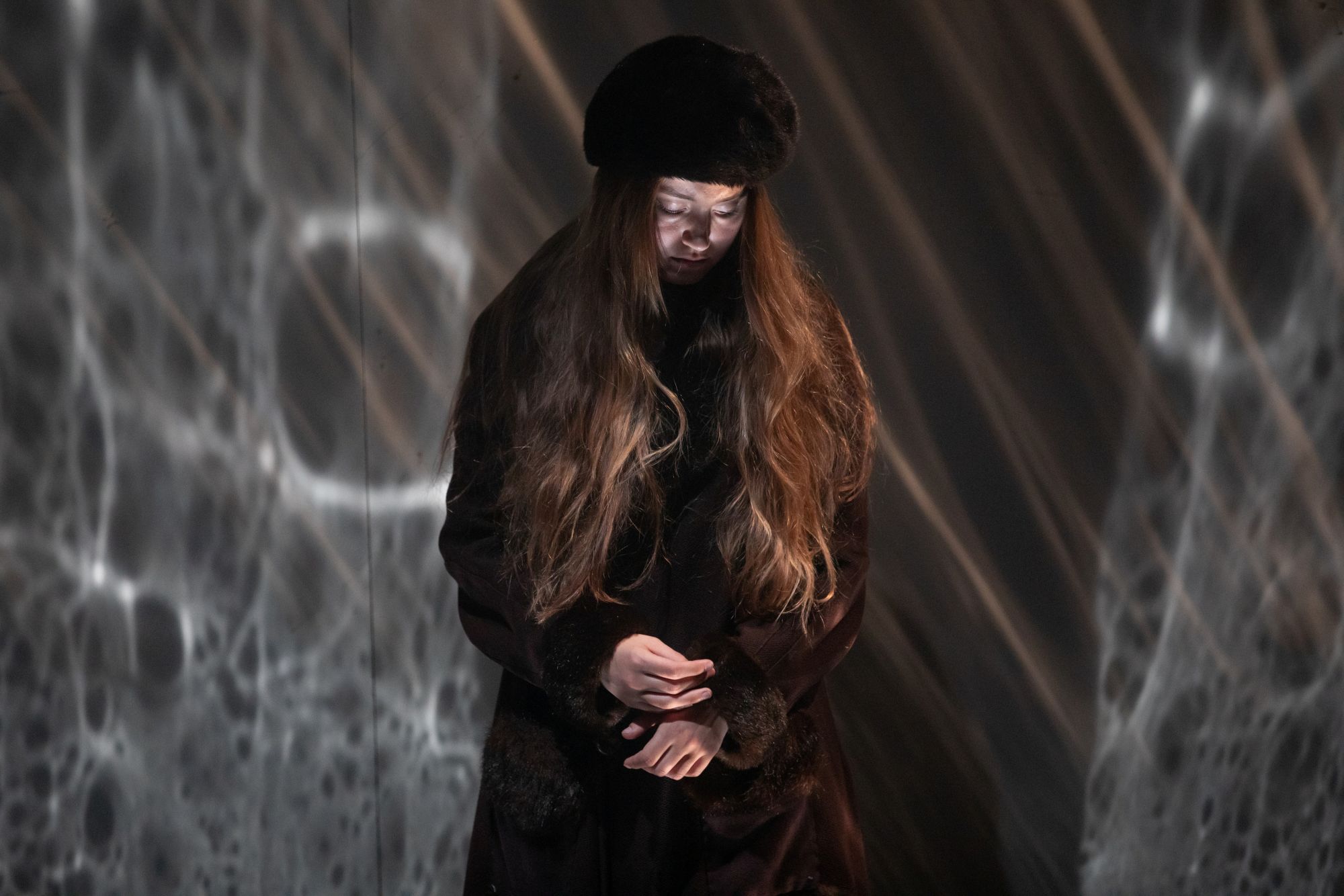
Thunder Road Theatre are breaking boundaries with The Void, produced by Alex Moran, written and directed by Ryan Simons, the show that seems to have stepped straight out of the cinematic universe of horror.
We’ve been watching sci-fi horrors on screen for decades with the likes of Alien, A Space Odyssey, Life, or Black Mirror’s Beyond The Sea; there’s a wide range of filmography that inspiration can be drawn from. Combine those with a light exploration of age-old haunting horror, the topical threat of AI and corporate control and you have the extended list of mismatched themes that The Void explores.
Beginning with a startling flash of lights and green text appearing letter by letter on a circular screen centre stage, the play commences. It’s the year 2160, there are no governments left, only corporations. A one-eyed space ranger with a mysteriously wiped memory, Flint (played by Alex Moran), is in orbit of Saturn’s largest moon; Titan. The marine is guided by AI entity, Nova (Olwen May), towards a derelict spacecraft named The Odyssey.
The Void presents a plethora of incredible technical prowess from the production team. Caitlin Mawhinney’s imposing set of a weathered spacecraft is lit by Andrew Croft’s crafty lighting design, which amplifies the set and is cleverly used for the occasional jump scare or moment of suspense. Fine Entertainment worked with the production as Illusion Designers and are presumably responsible for the mystical moment that Moran magically disappears offstage in the blink of an eye under a flash of lights, as well as his gravity-defying spacewalk.
The awe-inspiring creative design elements of the show are a marvel, but they’re let down by the not-so cohesive plotline giving the audience whiplash with every unexpected twist left unexplained. It’s clear that the show was heavily influenced by cinema and wanted to honour its inspirations, but it might have been more impactful had it explored its primary theme, AI control over humans, with more focus. So much time was spent creating allusive mystery in the plot, which was never truly unravelled or explained. The writing of the protagonists also suffered from this hell-bent attempt to create suspense, they remain entirely unrelatable to the audience with all their dialogue spoken in tense whispers or angry screams while never revealing any true vulnerability.
While at times incredibly connected with their characters, there is something jarring about the performance of both Moran, playing Flint, and Simons, playing Blair. Moran seems stunted by a pan-Atlantic accent that doesn’t seem entirely necessary with two English accents already in the show and another American accent appearing through video logs of the ship captain, Phoebus, played by Riana Duce. Duce’s performance in these fleeting displays was the strongest of the entire production, finally exposing something that felt tangible and real to the audience, if only for a few moments.
Not so tangible or real, was the production’s use of (what appears to be) AI imagery throughout the production. It is possible this was an attempt to comment on corporate use of AI and its uncanny, otherworldly appearance. But it seems an odd choice for a production to depict terrifying predictions of how AI may come to control humankind and then use that same AI technology to cut creative corners in a production that was otherwise incredibly well-designed by humans.
Although it has its downfalls, The Void has braved an incredible challenge that feels truly unique by putting sci-fi horror on the stage. With a few tweaks in the script, and an eradication of AI videos, the production has potential to achieve great things.
Reviewer: Ella Beckley
Reviewed: 7th October ‘26
Theatre Muse UK Star rating: ***