
Coming to the Fringe for the first time, Italian company Sisifo production presents Ten Ways to Die Happy, an adaptation of the Italian production Dieci Modi per Morire Felici, written and directed by Emanuele Aldrovandi and presented in collaboration with Emilia Romagna Teatro Fondazione.
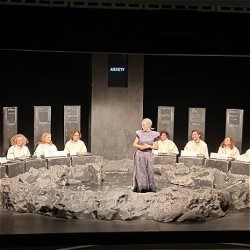
As you enter the theatre, you’re given a slip of paper with a number next to a skull and cross bones – morbid! The set is one of the more elaborate sets I’ve seen during Fringe; eight chairs sit in a semi-circle around what sounds (from water splashes) like a rock pool, the front part of the set blocks any view of the pool from the audience. Behind this is a large rectangular grey block, which looks a little like TARS, Interstellar’s monolithic robot.
After naming her robotic assistant Jerry, the show’s host, Perla Ambrosini, summons audience members to take part by random number generation. Each participant is then given a defining attribute such as beauty, intelligence, creativity, or in one case – extreme poverty.
In front of each player is a pile of flowers representing their lifetime supply of time and energy, and a changeable display of their happiness. Ambrosini then narrates us through these players lifetimes, with each year that passes an incredibly jarring and loud sci-fi sound effect reverberates across the theatre and players must throw a flower into the water of life. Occasionally, Jerry’s screen will light up like a magic-8-ball with a milestone of life that players must take on. The repetitive structure soon became dull and felt like sitting through a compulsory presentation rather than an engaging show.
The concept of this show has potential to be beautiful. But instead of making a profound comment on the unjust nature of life and how we’re all thrown into this absurd mess together and must play the cards we’re dealt, it became shallow. Trivialising real struggles like extreme poverty (as they put it) into something that prevents a child from going to school because they’re ‘too busy dealing with other problems like malaria and malnutrition’ isn’t a humorous thing, it’s distasteful. There were several moments like this that felt incredibly insensitive. Making life into a gameshow meant that someone could ‘win’ at life because of their own audacity and audience favouritism, which I suppose has some truth to it.
While some punter reviews on the Fringe website describe Ambrosini’s ability to memorise the events of each players’ life as a very impressive skill, with this version of the show it felt like she had forgotten everything entirely and sometimes needed reminders from panellists. Maybe that has something to do with it being at the end of a month-long run at Fringe.
Hopefully the production company can come back next year with a more refined show, as it has potential to be interesting. It’s also worth noting that some of the humour and impact of the show could have been lost in translation from its original Italian dialogue.
The show’s run at Edinburgh Fringe Festival has now ended.
Reviewer: Ella Beckley
Reviewed: 30 August 2026