
Photo credit – Andrew Ab Photography
In my quest to find out more about developing improv shows, I went along to a workshop hosted by The School of Night to see how twelve brave neophytes went on under the guidance of the masters. The workshop was conducted with the assumption that there was no prior knowledge of speaking in iambic pentameter, and in a short three-hour session, the tutors were to prepare the players to perform that evening. For those of you who do not know The School of Night, they are a group of improvisers who take their language skills very seriously, improvising in the style of Shakespeare, Chaucer, plus many others, with an adaptability to stylise their performance, according to playwright suggestions from the audience. As you can imagine, a great deal of knowledge and experience is needed to be able to perform in this way.
Workshop

Photo credit Andrew Ab Photography
The two members of The School of Night (SON) co-ordinating the workshop were Oliver Senton, and Dylan Emery. They began by asking what Shakespeare means to their students – frustration, terror, speaking like Yoda, fun with metaphors, these were replies to the question. Ask yourself, not how to do better impro, but what are you trying to improvise (do the work on what you are trying to create)? So for example, if you intend to create Shakespeare – know your Shakespeare, or musical improv – know your musicals.
Standing in a circle, they read from a section of Macbeth and then discussed what the passage meant – it was easily understandable, Shakespeare is not to be feared but make sure you understand the motivation behind the speech. They moved on to the rhythm of Shakespeare’s speech – de-dum, de-dum, de-dum, de-dum, de-dum, five pairs of syllables per line of speech, and began by practicing how the rhythm felt just using easy sentences and counting the time on their fingers and not worrying about the content.
Instead of fearing iambic pentameter, treat it as though it is your friend, the rhythm can help you, and as you progress, you will begin to form your thoughts in iambic without any overthinking. Try not to get into the habit of rhyming as it can be a difficult habit to break and makes it harder when improvising, let go of the control and learn to speak it naturally. Following on from this was repetition exercises, finding anything to say in iambic and committing the pattern to memory, this is something that can be done regularly, and anywhere to keep up this skill and to develop it.
The second half of the workshop, was to move their newly learned skills into scene practice. At this point many of the students were still using their fingers to help with the beat of the iambic, and the advice is once again, to concentrate on the rhythm and not to worry too much about the content. Added on to this already difficult skill – look at your audience; if you say something illogical you can make up for it in your next line; draw on the emotions of your scene partner, and send the audience’s attention to them. Building a scene gradually, a scene with two lovers is used as an example, the instinct is to use continuous high emotions, but that is not natural, move between the different humours – sanguine, choleric, melancholy, and phlegmatic. Also, move around the stage, and do not skip over key facts, interrogate them.
Performance

Photo credit – Andrew Ab Photography
I could go on with more workshop sage advice, but I hear you shouting – get on with it!!!
Onwards to the performance that evening. The group of eleven performers joined members of The School of Night, Oliver Senton, Dylan Emery, and Michael-Joseph Chance, to try out their new skills. The veil of secrecy has been lifted, and The School of Night’s procedures have been shared. Straight into requests from the audience – which style of Shakespeare play would they like to see, comedy, tragedy, history, or late play? It is closely run thing between comedy and late play, but late play wins the vote! The play will have severe weather; and hail and thunder will rain down on the players; it will be supernatural, with a manatee, a witch – and a crow finds its way in somehow. This performance comes with a health warning – it may be physically dangerous, so do not attempt it without the supervision of The School of Night!
This fast-paced show tests the skills of the improvisers, a boring Lord scene, with Lord Farthingale and Lord Swithingforth, one with expertise in folk beliefs, and the other with a love of pies. A King who is well ahead of his time discussing global warming, with backing dancers no less. A three-legged minstrel called Estelle, a song called ‘Hey Naughty, Naughty,’ and a King called David Attenborough, with Queen Grizelda who has an interest in boats, and wishes to sail. But beware Queen Grizelda, your maid is not all that she seems, is she plotting against you?
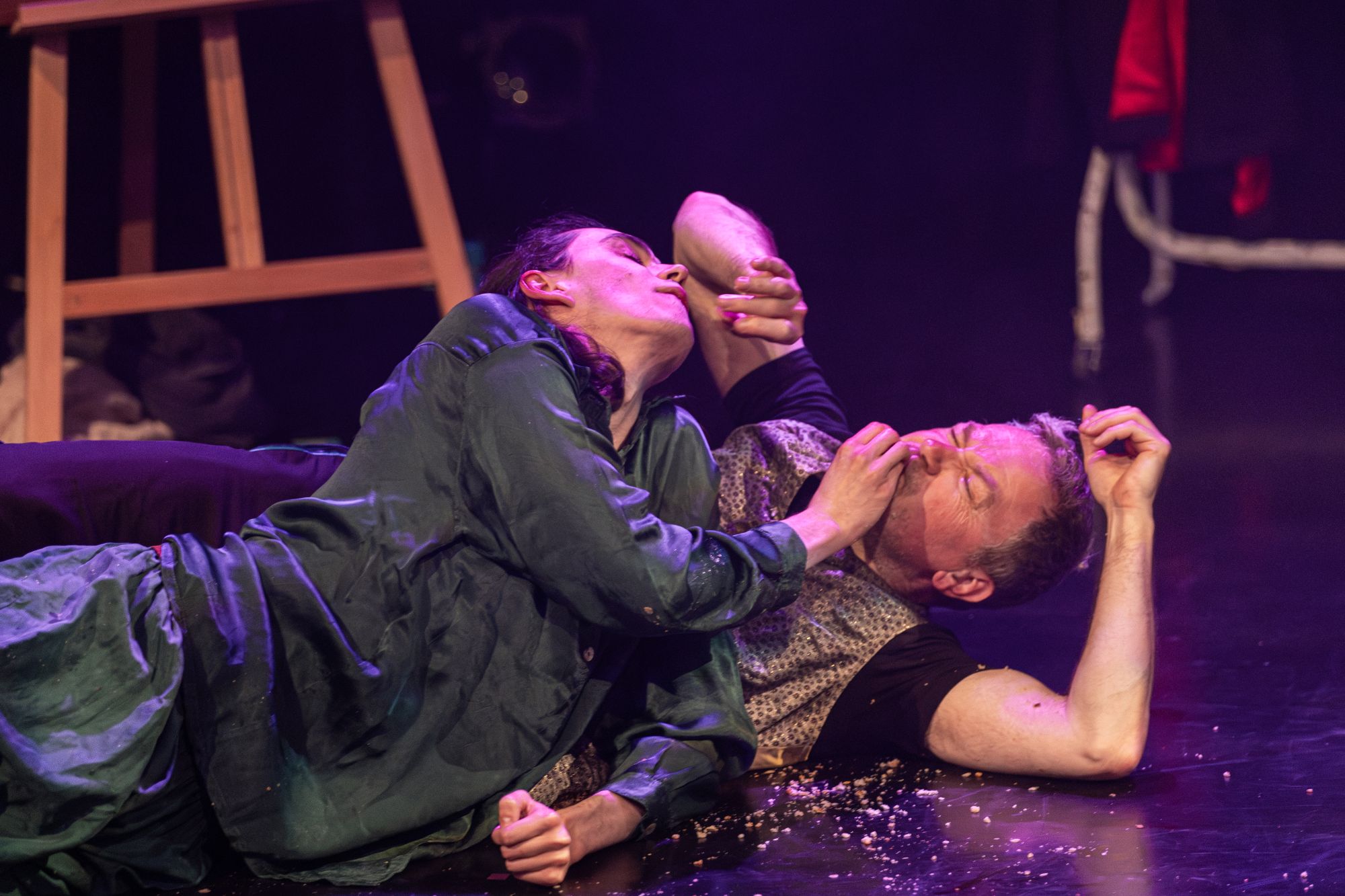
Down by the dockside, the workers Fart Bumble and Fickle Bottom get on with their day as the Queen goes to sea and arrives in Xanadu and the Queen and her maid check into their hotel (and that statement alone, is very much ahead of its time). Xanadu is unique, as it comes with its own manatee and witch. The manatee has its own personal echo (you really could not make this up…oh, but they did!). As the maid reveals her intention is to overthrow the Queen, behind her the manatee and the witch must eat a delicious blueberry muffin without being seen by the maid. This is messily done by the manatee and his echo, and a clean-up in aisle ten is needed.
The end of the play involves incorporating the four humours (see above) into a speech, and the exposure of the maid’s evil plotting, but the Queen has the upper hand as she suspected the maid’s wrong doing all along. The manatee enjoys another meal of ‘evil maid’ and the finale is a sonnet about jealousy and betrayal.
I must congratulate the students. They took on a difficult challenge to only have three hours of training to be able to extemporise in the style of Shakespeare, but fortune favoured the brave, and they were magnificent. The School of Night were excellent teachers, and supported the performers, whilst also making it challenging, and interesting for the audience to experience. The atmosphere was electric in the theatre, so a huge well done to all involved!
Full list of participants – Joe Donne, Mike Burton, Victoria Brocklehurst, Matt Sparkes, Christine Bradbury, James Ryan, Terje Brevik (workshop only), Diana Brown, Paul Arends, Hal Munger, Stephen Longstaffe, Kristin Elliott.
To follow ‘The School of Night’ and to find out about their future shows, go to – https://www.theschoolofnight.com/.
To stay updated with news of next year’s Liverpool Improv Festival, go to – https://www.liverpoolimprovfestival.com/.

Photo credit for all photos – Andrew Ab Photography